
Auditorium & public-address
AV systems in Nepal

An auditorium has one job the audience judges instantly: can the person on stage be heard, clearly, from every seat? Not just the front rows — the back of a 3,000-seat hall, over the air-conditioning and shuffling feet. That’s a speech-intelligibility problem before it’s an equipment one, and it’s what we solve. Aecom by VIE TEC (Aecom Pvt Ltd) designs auditorium and public-address systems for schools, colleges, and government and civic institutions across Nepal.
01.

The halls we’ve built

The 3,000-seat Bhaktapur City Hall. Whole-institution AV at the Nepal Police Club — main auditorium, multiple halls, and building-wide public address and background music. Council assembly (Sabha) halls in Damauli, Doti, Nepalgunj and Butwal. School and college auditoriums including Kathmandu World School, Pathshala, Global College and Reliance College. Civic scale, campus scale, and government tenders — the same engineering behind each. See more of our AV Work

02.

Every seat hears the same thing

The measure of an auditorium system isn’t how loud it goes — it’s whether the back row understands every word as easily as the front. That means even coverage with no dead zones and no hotspots, speakers aimed and time-aligned so the sound arrives together rather than as echo, and enough clarity that a soft-spoken chief guest is as intelligible as a practised one. In a 3,000-seat hall that’s a design problem, not a volume knob. We solve it at the design stage, then specify the system to hit it.
03.

Big halls fight themselves

A large hall with hard walls and a high ceiling is a difficult room before it’s an AV one: sound reflects, speech smears into echo, and a system fighting the room feeds back at the worst possible moment. We design the coverage around how the room actually behaves — where the sound needs to land, where it bounces, where it has to be controlled — so the system works with the hall instead of against it. That’s the difference between a hall that’s clear from every seat and one that never quite works no matter what’s installed in it. The gear is professional-grade and specified to the hall, not pulled from a catalogue: TOA, Yamaha, Extron, and Shure among them. TOA’s public-address systems in particular are built for large, speech-first spaces — the reason they turn up in halls and civic buildings rather than living rooms.
04.

Whole-institution AV — the Nepal Police Club

At the Nepal Police Club (The Blue Pavilion), the brief wasn’t a single room — it was the building. We delivered the main auditorium, multiple smaller halls, and public address and background music across the entire premises, coordinated to work together and controlled centrally. One institution, one integrated system, one team accountable for all of it. It’s the kind of project that proves a supplier can carry scope from a single stage to a whole building without the seams showing.
05.

Built for government tenders

Much of our auditorium work is public — council assembly halls, city halls, and campus auditoriums, won and delivered through tender. We work to your tender document and deliver exactly what it calls for: the specified equipment supplied and installed, the technical submittals and compliance documentation the tender requires, and a documented handover with staff training. The Sabha halls in Damauli, Doti, Nepalgunj and Butwal are exactly that — government projects delivered across four districts, to specification and signed off.
06.

Engineered, not just installed

Equipment is 60% of an AV system. The other 40% — coverage mapping, system design, DSP tuning, control programming — is the reason one hall is clear from every seat while another howls with feedback halfway through the opening speech. Anyone can supply and hang the speakers. Whether the hall actually works is decided by the 40% that isn’t in the box. We do the 40%.
07.

Runnable by the people who actually run it

A school auditorium is operated by teachers, a Sabha hall by administrative staff — not AV technicians. So we commission against the design, train the people who’ll run the events, and leave documentation they can actually use. Maintenance contracts keep the system calibrated and covered, with a named team to call.
Just a room and a requirement?
We can design it.
Not every project starts with a finished tender. If you have a hall and a requirement but no specification yet, we can help from the design stage — assessing the room, sizing the system to the seat count and how the hall will be used, and setting out exactly what it needs. Bring us a tender and we deliver to it; bring us an empty hall and we’ll design it with you.
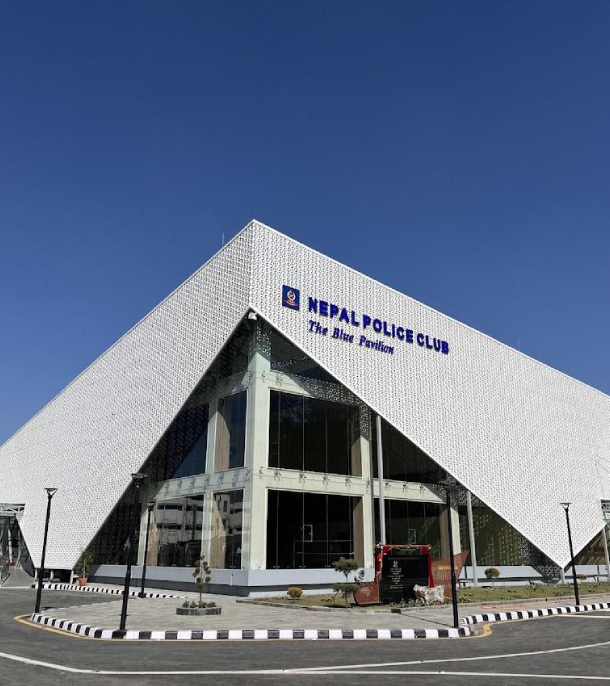
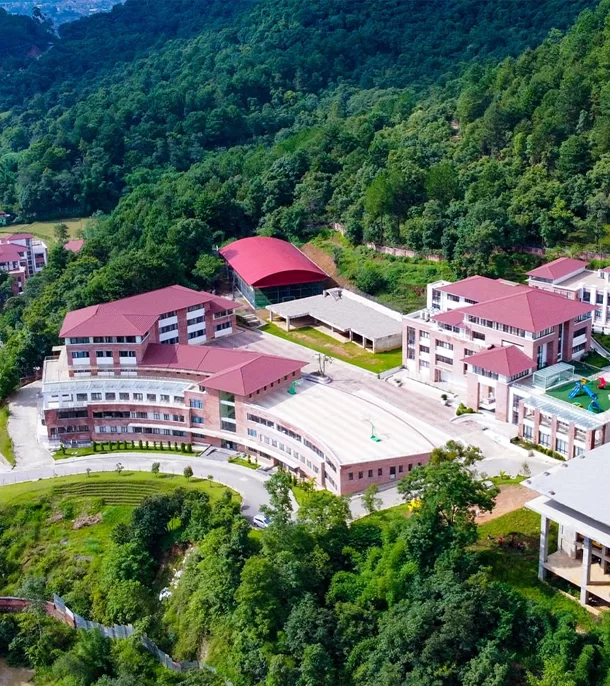
Nepal Police Club- The Blue Pavilion

Voice evacuation system, Background music system, AV System (Auditorium)

Kathmandu World School

AV System (Auditorium), Pro audio system
    Frequently Asked Questions
    1. Will every seat hear the speaker clearly, even in a very large hall?
    That’s the core of what we design for — even coverage and speech intelligibility to the last row, worked out before the system is specified. We’ve delivered it at the 3,000-seat Bhaktapur City Hall.
    2. Can you work to a government tender or our consultant’s specification?
    Yes — we deliver to your tender document or your consultant’s spec: the right equipment supplied and installed, technical submittals, compliance documentation, and documented handover. Most of our institutional work arrives through tenders.
    3. Is Aecom by VIE TEC related to the global company AECOM?
    No. Aecom Pvt Ltd is a Nepali company, VIE TEC’s audio-visual division, operating in Nepal. It’s unrelated to AECOM the multinational — same sound, different company.
    Building or fitting out an auditorium, hall, or campus?

    Tell us the room, the seat count, and how it’ll be used, and we’ll tell you what it needs.